.png)
Post-Race Reflections From Our Athletes at the 2025 JFK 50 Mile

Race-Day perspectives from Shae Rhinehart, Robbe Reddinger, and Coach Greg illuminate the experience of JFK 50 for future runners

In this post, three Treeline Endruance athletes share their takeaways following the 2025 John F. Kennedy 50 Mile. Shae Rhinehart is a seasoned ultrarunner and marketing contributor at Treeline Endurance. Robbe Reddinger is Senior Editor at the shoe review website, Believe in the Run, and a Treeline Endurance athlete since early 2024.
In this post:
Greg's Take
Ahead of the JFK 50, I put a lot of thought into pacing strategy, and came away with some pretty clear guidelines to follow. Shae, Robbe, and I all took pace targets into race day based on that analysis.
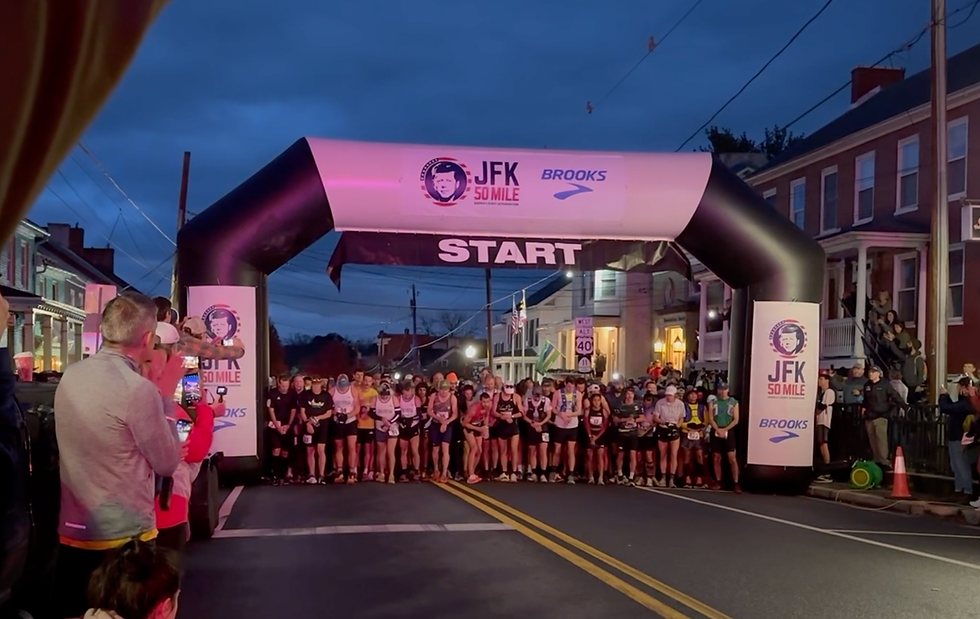
Race day this year was fairly typical for JFK: cool autumn temperatures, with partly sunny skies. There was some rain overnight, and all of us were considering how the wet leaves on the Appalachian Trail, which made up most of the first 16 miles of the race course, might influence pacing and risk of yard sale.
I won't speak for the others, but I was pleasantly surprised by this section. We had some heavy fog for the first few hours, but the leaves on-trail weren't as numerous or slick as I'd expected, and I was able to move along pretty steadily through the first 16 miles.

The trail is open to other travelers as well, not just race participants. I came across a hiker who had a big pack and looked like he'd been out for awhile, so as I ran by, I asked his name and how long he was out for. He replied that he was "doing all three" and his name was "Chezwick". Little did I know I'd just run into somewhat of a living legend. It was Nick "Chezwick" Gagnon, who is currently 7,000+ miles into a Fastest Known Time attempt for the Triple Crown of Thru-Hiking.
After a 60-second shoe-and-bottle-swap (Topo Athletic Ultraventure 3 -> New Balance 1080 v14) at Weverton Cliffs, I was on to the marathon of C&O Canal path that makes of the middle half of the race. Early on, I kept it steady, watching heart rate and pace to hold myself back, and keeping the focus on nutrition and hydration. This continued well to Mile 27 at Antietam Aqueduct, where I met my crew again for just a couple of minutes before heading out. The legs never fully loosened back up though, and the 10:15 per mile pace became 11:00. Not a huge deal. I was still right on the pace targets for all of these segments.
"It was Nick "Chezwick" Gagnon, who is currently 7,000+ miles into a Fastest Known Time attempt for the Triple Crown of Thru-Hiking."
At Taylor's Landing, Mile ~39, I was feeling worked, but not abnormally so. The legs were still turning over fine. I met my crew again for another 2-3 minutes, but the legs left me here. In just that 2-3 minutes of standing still, they'd stiffened right up. No matter how I tried to get them to loosen up over the next 5K to the Dam #4 aid station, I couldn't get the pace back to where it had been. It felt like I must be behind on sodium, so I started hammering chicken broth at aid stations to try and bring them back to life. Alas, there was no saving them, and it was a determined shuffle to bring it home in a finish time of 10:14:42.

Shae's Take
Footwear: In 2023, I wore Hoka Challengers for the whole race and the shoes were solid both on the trail and the road. This year, I tested out swapping shoes; I wore Hoka Speedgoat 5s for the trail portion; they were grippy and perfect for the wetter trail conditions and then I switched to Saucony Guides at Weverton Aid for the rest of the race. My feet definitely appreciated the cushier shoes and it felt like a fresh start, mentally. A couple of the people around me also commented on how much they appreciated switching their shoes at this point.
Switching shoes was also helpful, because I had kicked up dirt and small rocks into my shoes on the Appalachian trail section, and switching shoes forced me to take a beat to make sure my socks were fresh and free of any debris before launching into the rest of the race. This is notable, because I experienced a lot more issues with gravel and debris this year than in 2023. In particular, between Antietam Aid and Taylor’s Landing Aid, I got a lot of small rocks and sand kicked up into my shoes, which really started irritating my feet. I pushed to Taylor’s Landing before taking my shoes off to dump the rocks out, but I definitely think some lightweight gaiters would have been helpful to keep my shoes cleaner. This was not an issue in 2023 when it was warmer, so I’m not sure if it was merely a condition of the trail this year, or if it was weather related, but debris was a much more significant annoyance this year and next time, I’d proactively wear some lightweight gaiters like the thin ones you can get from Altra, Ultimate Direction or Dirty Girl gaiters.
I wore Injinji toe socks both years. I generally love injinji toe socks… and didn’t get any blisters in between my toes, but both in 2023 with just the Hoka Challengers and this year, switching between the Hoka Speedgoats and Saucony Guides, I got gnarly blisters around and under my toenails. I also just generally chipped my toenails up, despite having cut them really short prior to the race. After talking about this at length with Greg and assessing exactly where my blisters were occurring, I realized that with flat feet, going beyond 30 miles means I might need to start sizing up my race shoes an extra half or whole size. Can’t blame the terrain since JFK 50 mile is so flat relative to other ultramarathons. Lessons learned.
Race Info: There were 1,221 entrants and 1,111 finishers. 261 women this year. I actually noticed more women on the course than in 2023, which I just loved (and when I checked, there were 196 women two years ago, so that tracks!). It’s also particularly inspiring for me to see the thirteen women aged 60+ who ran the race this year. I’d love to be like them one day.
I saw some fun characters on the course too! The "Mr. Incredible Marathon Bike Guy", Paul Silberman, who “famously” bikes alongside many marathons on the East Coast was back at it again this weekend, with speakers and a large American flag. The fun tropical vacation luau aid station popped up again this year, with six miles to go. I didn’t see the usual Christmas-themed aid station, though, or Santa Claus. Ultimately, it wasn’t missed though with all of the amazing volunteers at this race who make it so special. Their energy and generosity is by far the most memorable part of this race, every year.
In general, I love how social JFK 50 Mile is. Sure, there are some quiet stretches on the C&O path, but most of the time you’re around people, which isn’t a given at many ultramarathons. Runners from all over, first-timers, veterans, locals, even people from Ireland and the UK are running all day together for hours, and you get to meet a ton of people running for tons of different reasons. Hours of opportunity to make new friends!
"Weather can be fickle in Maryland this time of year. You could have clouds, sun, humidity, rain and even snow, so a backup shirt or layer on course with your crew (if you have one) is smart."
Weather: The weather had been rainy leading up to the race, this year, but thankfully race day itself was dry. The leaves and rocks were a bit slick on the trail, but by the time I came through in the middle of the pack, it was packed down enough that it wasn’t bad. There were some serious bottlenecks around mile 5.5-6, however, right at the top of the primary climb on the access roads to the Appalachian Trail. It was a literal standstill for a minute or two, then a slow walk for another 5+ minutes. It was slow going, but the terrain was high and narrow there, so there was no passing. While I experienced some bottlenecks via general slow downs where you had to work to pass people in 2023, this year was much more significant and I heard many people around me agreeing that this was uncommonly bad. I’m not sure if it was due to the wetness of the section and inability to pass, or if it was primarily due to us all getting unlucky behind an unusually slow or cautious runner in that section, but it added many minutes onto our time there!
Weather-wise, it was rainy and cool at the start, this year, but a t-shirt worked perfectly. In 2023, it was colder at the start and I wore a long sleeve, but the sun came out in full force soon after. By the time I got off the Appalachian trail, I got too hot, and had to change mid-race. Weather can be fickle in Maryland this time of year. You could have clouds, sun, humidity, rain and even snow, so a backup shirt or layer on course with your crew (if you have one) is smart. The AT was foggy and cool this year and clouds persisted on the C&O trail but the temperature was in the 50s overall, so a T-shirt was perfect. By the time I hit the road at sunset, however, it started to cool down very fast. Outfit choice really depends on your pace and where you are geographically in the race.

Terrain: Coming down the cliffs to Weaverton, you hear a lot of people talk about how steep it is - and sure, it is steep. It’s narrow and generally a no-pass zone for large stretches. I actually got stuck behind a med crew walking down someone on a medical gurney this year, so you can absolutely have serious falls. But having run trails out west, the steepness and exposure didn’t really compare. The key is just taking your time, in this section, in particular because you’ll be stuck behind people anyway.
Additionally, a word of caution: people get stuck at the train tracks before the C&O path. Not talked about much, but it happens. You won’t be alone if it does, but just be aware of the possibility.
And a tip about the final stretch… both in 2023 and this year, when you reach the last 1.6 miles, the cops blocking the road tell you that once you crest the top of the hill, it’s “all downhill and flat to the finish.” They are so, so wrong every time (why do they say that?!). It’s downhill for a moment, then uphill to the finish. Additionally, I’d argue the last eight miles are generally hillier than most people expect. It’s not anywhere as steep as the first 16 miles of the race, so it doesn’t show up much on the course elevation profile, but at mile 41+ you will feel them. The first hill once you hit the road section is definitely steep; following that first climb, there are no serious hills, but the rolling ups and downs continue all the way to the finish. Thankfully it’s a quiet series of roads and feels very scenic following all the miles you will have just spent on the C&O “treadmill”, but still, expect hills the whole way.
Aid Stations & Fueling: Aid stations! Honestly, it can be tricky to find solid info on what’s actually at each stop, along the course, so I brought all my own fuel both in 2023 and this year. This time it was mostly Precision Fuel, a couple Maurtens, and a flask of Dewaultermelon Tailwind that I refilled three times. Aid stations had water and Gatorade, plus food like M&Ms, pickle juice shots, Coke, Mountain Dew, chicken broth, PB&Js, chips, and salt potatoes. They even had Hammer gels, which I think were caffeinated. Volunteers were fantastic, quick to help with refills, and just super friendly. Every aid station also had a restroom and occasionally you’d see a surprise restroom peppered in between stations on the C&O trail.
This year, for the first 16 miles, I carried 1.5 liters of water; in 2023 I felt like I had to ration my water a bit more and suffered for it. Carrying more worked out well for me this year and I was able to ditch a bottle at Weverton at 15.5 miles with my crew. I carried just two bottles the rest of the way. I’m sure you could easily get by with one bottle the whole race (or none, depending on your pace), there were many people carrying more minimalist hip belts. I liked being able to have electrolyte drink mix in one bottle and water in the other, however. I’d follow this strategy again this year.
Pacing: My coach Greg built out a structured pace plan for me for this race this year that I found extremely helpful to keep me focused on one segment of the race at a time. The first 16 miles were one segment of my “workout” with an average pace of 13 -14 ish minutes. I was slower than this on some of the hills and faster on the flats and downs for this trail portion, but it definitely helped keep me aware. I also was more cautious about pushing my HR too high this year, as I pushed too hard on the early hills in 2023 and had to slow way way down to get going again on the initial climbs before connecting with the AT. I was more aware of keeping my zones controlled in the first 6 miles this year so that I could really work to make up that time on the ridge once you get past the initial climbs.
"Coming down the cliffs to Weverton, you hear a lot of people talk about how steep it is - and sure, it is steep. Having run trails out west, the steepness and exposure didn’t really compare."
After Weverton, I started my 11.7 mile section where my target pace was closer to 12 minutes - this section was 11.7 miles because that was the distance to the next biggest aid where my family would be to meet me with bottle refills and new gels (and smiles!).
Next was the most mentally challenging section for me, between Antietam and Taylor’s Landing, but I expected it this year. The aids are a little farther apart in this section (4 miles, 4 miles, and almost 4 miles again) and you’re on the same-scenery canal path still, so it can absolutely drag. Having my pace for that section and seeing the mileage count down from 11.4 was extremely helpful in keeping me moving at and faster than my goal pace.
Finally, after seeing my family at Taylor’s Landing, my last 3 mile segment started with a slightly slower goal pace, as I ran to exit the C&O path. These segment landmarks on my Garmin were SO motivating.
Hitting the last 9ish mile road section, my watch started its final segment and I got to watch the miles tick down (both on my watch and on the road, as they put out signs counting down to the final mile in this section) and given the hilliness of this final stretch of the race, I can guarantee I would not have been able to push my pace going up the countless little hills on this section, had I not had my pace ranges set on my watch reminding me to keep up the pace if I wanted to reach my goal and PR.
Ultimately, I crossed the finish line with a 20 minute PR and was absolutely ecstatic. Great idea by Greg and definitely something I recommend for others in terms of how to break up the race mentally and in terms of your goal paces.

Robbe's Take
The JFK 50 Mile has always been at the top of the race bucket list for me. I’m from Baltimore and have bikepacked the Harper’s Ferry to Williamsport section of the C&O towpath several times and have also hiked and ran the Appalachian Trail in Maryland and Pennsylvania, so the race tied in a lot of my interests.
My training wasn’t great for this, as life and work and pop-up injuries had set me back throughout the last four months. I looked back at my Strava and realized I’d only had a handful of 40+ mile weeks this whole year. Nevertheless, I hit most of my long runs this training cycle and also completed the New York City Marathon, so I felt like I could do the distance.
I had looked at Greg’s pace chart that he laid out for JFK and felt like I could manage the 10:30 paces. I broke it down like this, with the times on the right being my actual times during the race:
14:19 // to 15.5 (15 mi.) - 13:10
10:23 // to 27.3 (12 mi.) - 12:04
12:20 // to 38.7 (11 mi.) - 12:22
13:14 // to 41.8 (3 mi.) - 12:07
11:26 // to end (9 mi.) - 11:12
I did a test run of the AT section the week before and the leaves were fluffy and abundant, covering everything. It did not go well, with a couple rolled ankles.
The weather was perfect on race morning as the rain had passed and the range was between 48F and 52F, which is quite rare for late November in western Maryland.
I took it easy on the 2-mile climb heading out of Boonsboro, walking at times and running at others. The trails were much different during the race, as the rain tamped them down and the 500 or so runners ahead of me flattened them out. The trails, in fact, were quite lovely, aside from the logjams that occurred on downhill singletrack sections where I really wanted to run but had no option but to walk.
"We were doing a minute and a half walk, then 9 minutes of running (at 9:45-10:00/mile pace). Every time we walked, I ate. "
There was also a standstill at the top of Weverton Cliffs, as someone had snapped their ankle and was being carried out on a stretcher.
I felt the worst at mile 11 as I became a little dizzy and felt like I had a bit of vertigo, probably because of the droning pattern of leaves and rocks and constantly looking at my feet trying to navigate it all.
The time on the trail was much easier than I had expected, even if I did go a little bit faster than anticipated. Coming off the cliffs and into the Weverton AS, the crowds were insane. Felt a lot like coming off the Queensboro Bridge in the New York City Marathon. That was a nice pick-me-up heading onto the C&O portion.
I had been running with a friend (Charles) that I ran into at the first aid station, we got separated but reconnected on the towpath and committed to a run/walk cadence. Initially we were doing a minute and a half walk, then 9 minutes of running (at 9:45-10:00/mile pace). This was fine for 5 miles or so, but morale sank a bit as mile 25 seemed to take forever to get to, especially as our watches had suddenly been off a mile from the course markings.
In any case, I made it a point to consume food at every aid station, whether that was PB&J, pierogies, fruit, or chicken broth. I knew this was crucial from the first 50-mile race I did 6 years ago. I was really terrified of bonking or losing steam with 10 miles to go, so I was just crushing calories. Every time we walked, I ate.
Here is what I ate for the entirety of the race:
6 Maurten (reg)
3 Maurten (caf)
3/4 bag of Nerds Gummy Clusters (awesome)
2 PB&J sandwiches
1/2 grilled cheese
3 pierogis
1 banana
2 handfuls of chips
Strawberries and watermelon
French fries
Red velvet cake
4 LMNT (64 oz.)
64 oz. of water
4 cups of flat Coke
3 cups of chicken broth
Getting past the halfway point was a huge boost. From there, we kind of settled into walking .15 miles, then running .85, which we did for about the next 12 miles. My partner was kind of starting to struggle a bit, having to take longer walk breaks and spending more time at aid stations. I promised I would stay with him until mile 40, but some other friends caught up with us and we separated around mile 38.
The C&O towpath is just a long tunnel of green with the Potomac off to the left. It’s a bit of a grind, but if you can find someone to link up with it helps pass the time. One interesting thing about this section is that I used to bikepack it all the time, but haven’t done so since 2020. In the past, it was dirt and grass and kind of rutted out. It could get super muddy, especially if it had rained the week before. This is what I was expecting.
However, they had apparently resurfaced the entire thing over the past few years, making it a smooth gravel with hardpack surface. So it was really smooth sailing the whole way. This also explains why there’s been so many course records since 2020, in case you were wondering.

All in all, I was feeling remarkably well aside from a few aches and pains here and there. I do regret not switching shoes once I got off the AT section. Instead, I had worn my Hoka Mafate Speed 4 Lite STSFY the entire time. This started to cause some issues because the laces on the Satisfy version are different than the standard Mafate Speed 4 Lite, opting for a thin quicklace system. Unfortunately, this started to give me significant pain on the top of my foot, not to mention that they had a low stack height for less comfort underfoot. At mile 38, I sat down and switched into the Tecton X 3, a carbon plated fast shoe but with much more cushion and a rocker geometry that keeps you rolling along. That was the right decision and I had wished I’d done it sooner.
Unfortunately, I did not make the “vest of shame” cutoff, arriving at Dam 4 around 3:30 p.m., where I was forced to don an oversized fluorescent vest as we headed onto the roads. The first couple miles of road seems to be uphill forever; however, I felt pretty good so was moving at a nice clip. I still stuck to the run/walk cadence but was definitely running faster, hitting sub-9-minute pace on the running portions. It’s so easy to think you’re close to the finish, but then you have to think you’re essentially at mile 17 of a marathon (the course clocked in at 51 miles on GPS). Lots of time to run, lots of time for things to go wrong.
Eventually, I couldn’t eat any more gels, so whatever was in me was what would get me to the end. The roads were rolling, but in a way that’s my favorite. I love running on backcountry roads, so it suited me completely. The sun was setting and washing everything in an orange glow, and it was just a nice and peaceful way to round out the day. Eventually, I did start to feel some fatigue setting in around mile 48 and found myself walking a little longer than I had wanted to. I also had some brain fog so couldn’t figure out my elapsed time on the day, because it wasn’t showing the seconds so I guess I got confused. Had no idea where I was timewise for the last half hour of the race.
"If you get a chance, you need to do this race."
Coming into town, there’s one more large hill by Sheetz and I couldn’t bring myself to run it, opting instead to walk the whole thing. However, after that, I knew it was only a mile to go, and I was able to push it in without stopping. I ended up having plenty of steam in my legs for the home stretch, coming in at a 7:30 pace.
My kids and wife were cheering me on in the finishing chute; on the other side were my friends who finished before me. I came through and clicked my watch– exactly 10:30:00. Nailed it right on the dot. I got my medal, spent some time with the fam, then went into the school gym where I took a nice hot shower, which was one of the highlights of the day. Didn’t have much of an appetite yet, so I just nibbled on some stuff.
We ended up going to a bonfire at our friend Reese’s house (she finished 10th on the women’s side!), where I had some pizza and beers.
After some reflection, I have to say that the race will go down as one of my favorite memories of all time when it comes to running. It was for sure the best I’ve ever felt in a race, which was super surprising considered I had averaged about 25 miles a week for the past 12 weeks coming into it. Now, some of those weeks were solid and I got in most of my long runs, including the New York City Marathon. But my training left much to be desired.
That said, Coach Greg stuck with me the whole way and helped navigate me through all the ups and downs of travel and injuries and managing plantar fasciitis and whatever else was going on. Somehow, he managed to get me to the race and across that finish line feeling better than I ever could have imagined. I’m super grateful for his support and can’t think of a better coach to have on my team.
Last note: If you get a chance, you need to do this race. It’s such a fun race on relatively mild terrain, with the right amount of challenging stuff and the right amount of variation to keep it interesting. Also, A+ aid stations and support. You can’t beat that for a Saturday in November.
Join the movement and realize your potential.
Sign up below to join the Treeline Endurance community and receive updates on our latest posts and offers. You can also follow us on Instagram and Facebook.



Comments